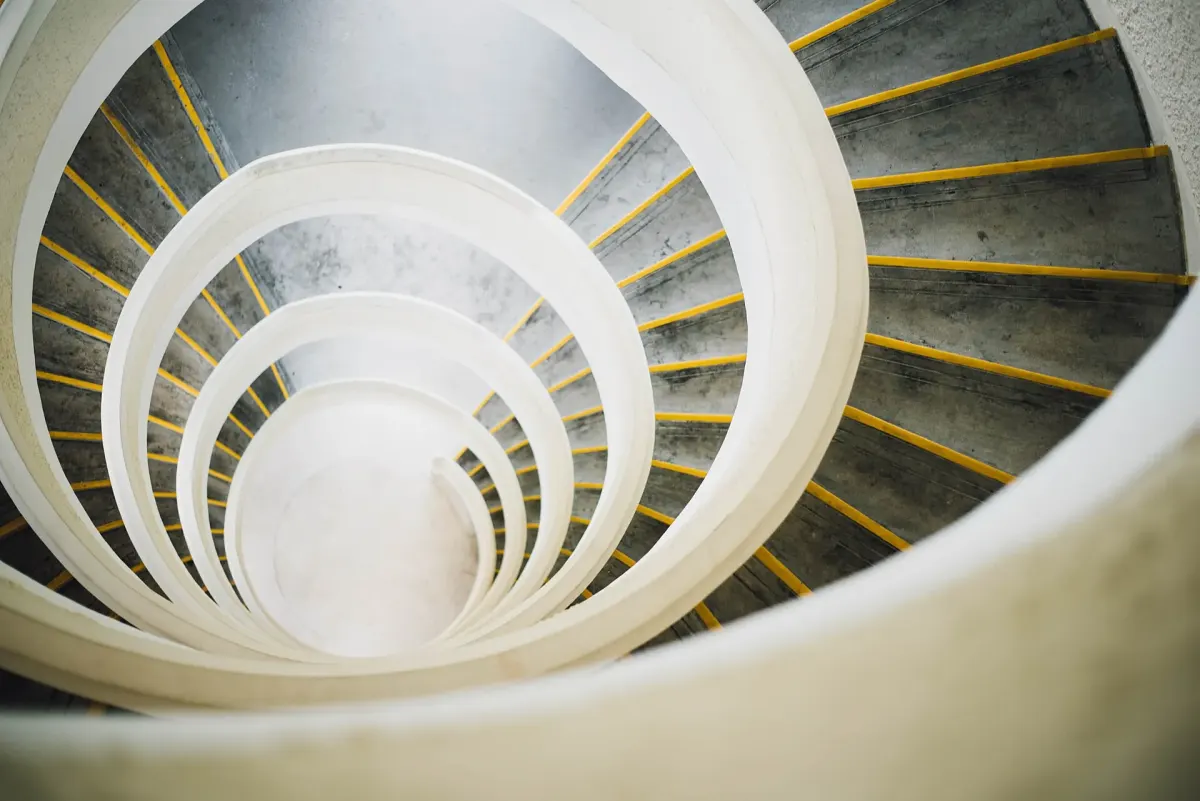
Looking down a stairwell is a different experience from looking up one. Up, the structure feels heavy and slightly threatening. Down, it feels like a drawing of a shell.
The ring and the step
The white rim of each flight forms a series of ovals, shrinking toward a pale landing at the bottom. Between the rims, the treads fan out in grey concrete. They are edged with yellow strips, and those strips are the true pattern in the picture, a row of short bright dashes that bend with the curve and mark off each step like a tally.
Without the yellow, this would be a nice tonal study in grey and cream. With it, the stair becomes readable, and you can count how far down it goes.
Where to stand
Most stairwells like this allow only a few good positions, and the best is usually right against the outer rail with the camera held over the void. Use a wide lens, keep the horizon level by lining up one of the rims, and take the picture when nobody is climbing. A single figure would be a story. The empty stair is a form, and that is the more graphic photograph.
There is a small cheat I would admit to. If a stairwell is dim, brace the camera on the rail rather than raising the sensitivity too far. A little grain would not hurt here, but a blurred ring would. Sharpness matters most along the edges of the treads, where the yellow meets the grey.
Spirals reward patience. Take several frames as you lean out and keep the one where the rings are most nearly concentric.