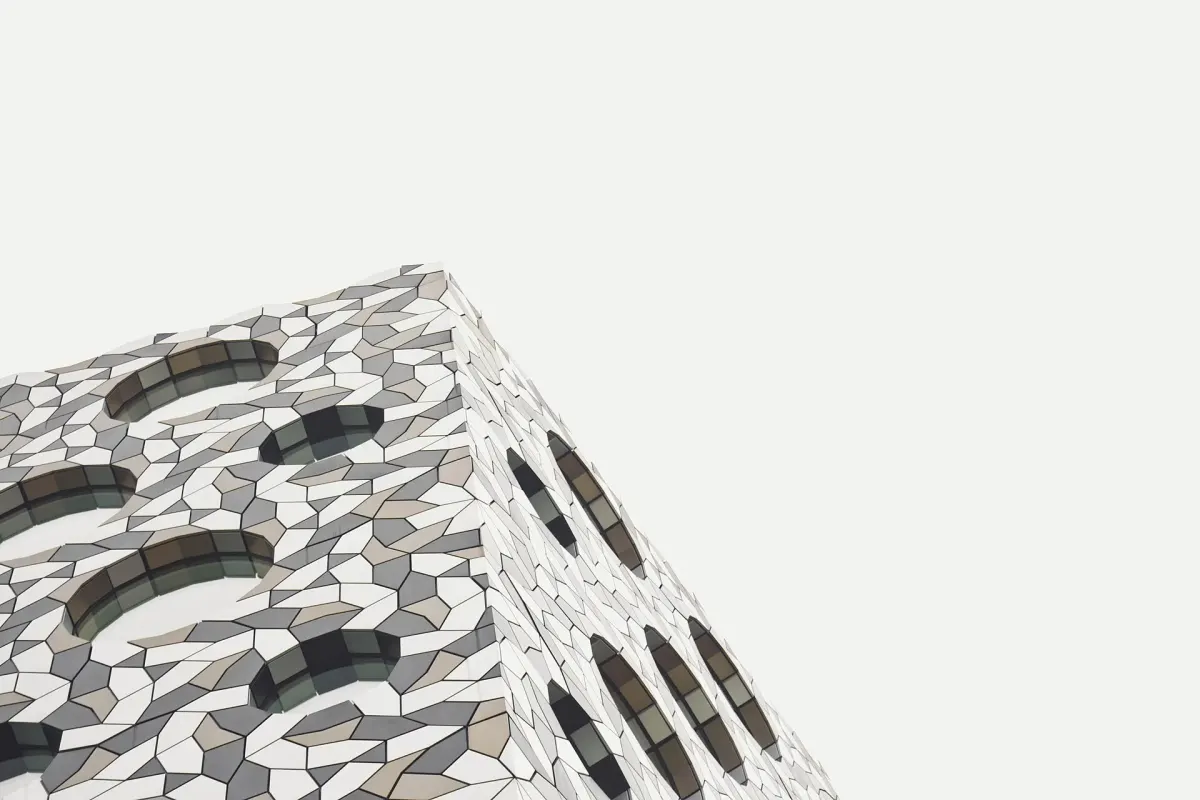
Most of this photograph is sky, and most of the sky is nothing. The building occupies the lower left, pushed toward the corner of the frame, and the empty space around it is what makes the cladding so loud.
Irregular but ordered
The tiles are small quadrilaterals in white, grey and a light sand colour. They are not random, since each fits against its neighbours without a gap, but there is no obvious repeat either. It resembles a puzzle that has been solved in a way that never quite settles. The oval windows break the surface at regular intervals, and their dark glass is the only deep tone in the picture.
Because the building turns a corner, the tiles on the right face are foreshortened into narrow slivers. That change of scale gives the otherwise flat pattern a sense of volume.
Room to breathe
The white sky matters. If there were clouds or a skyline, the eye would wander. Here it returns to the facade every time. When I see a pattern this dense, I look for the cleanest background available and shift the subject to a corner. Negative space is the cheapest way to make a busy subject calm.
One more detail: the white panels reflect so much light that the exposure had to be set for them, and everything darker is allowed to fall. In a pale picture the temptation is to brighten the shadows. Resist it. The dark glass in the oval windows is what proves that the white is white.
It is, in the end, a picture about restraint, and the corner of the frame is where the restraint is easiest to see.