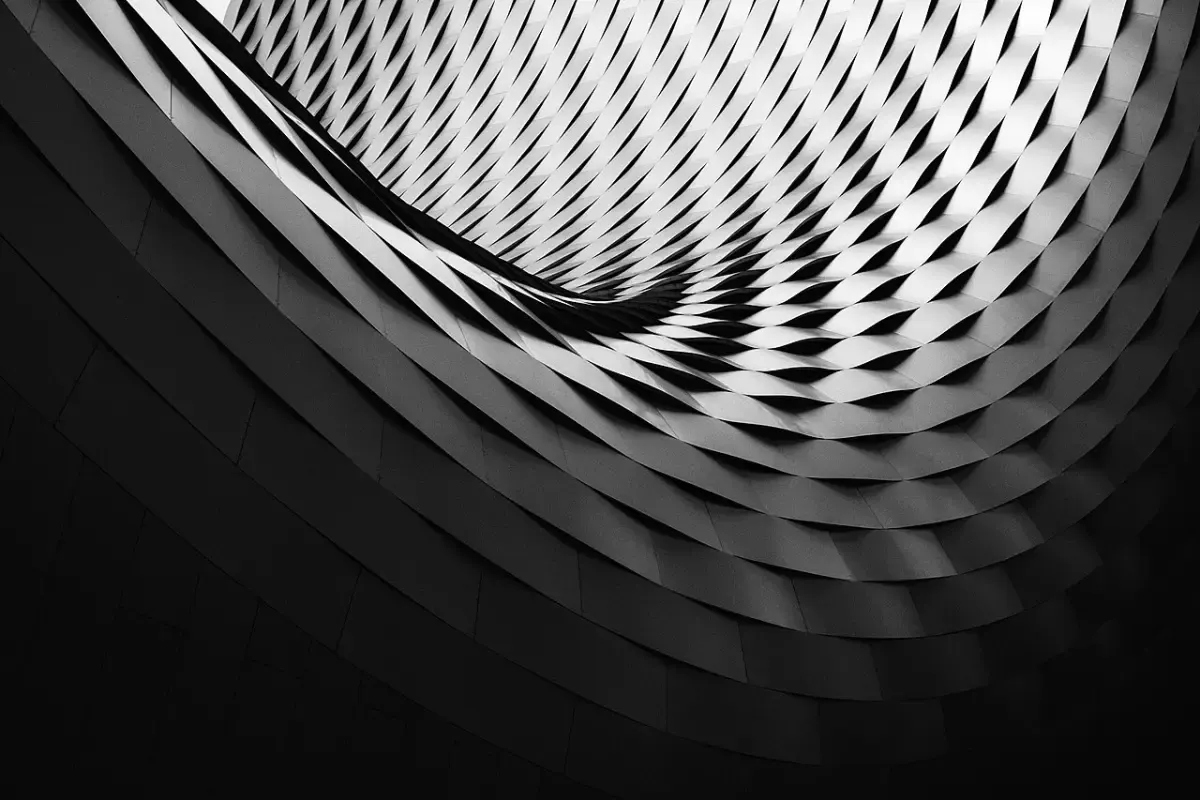
Nothing in this photograph is large. Each diamond-shaped panel is small, flat and almost identical to its neighbour. What makes the picture is the number of them, and the way the curve of the building asks them to lean a little further each time.
One shape, many times
Repetition is the oldest trick in pattern making, and it works because the eye is lazy in a useful way. After three or four panels it stops reading them as individual objects and starts reading the surface they form. The photographer has pointed the camera upward, so the rows run away from us and tighten toward the bright opening at the top. The shapes shrink with distance, the gaps close, and the eye follows them in a slow circle.
It helps that the panels are cut from a single material. There is no second colour to argue with the first. The only variable is how much light each facet catches, and that variable is doing all the work.
Where the light lands
Look at the left edge. The lowest rings are almost black, then a band of mid grey, then the brilliant lattice at the centre. This is a gradient made of steps, and each step is one panel wide. Black and white photography suits it, because colour would only add a decision the viewer does not need to make.
Three things to notice when you study a picture like this:
- The direction of the diagonals changes where the wall bends, and that change is the only drama in the frame.
- The darkest area sits in a corner and gives the bright area room to be bright.
- No two diamonds catch light quite the same way, so the pattern never quite repeats.
The break in the order
A perfect pattern is a wallpaper. What turns this one into a photograph is the seam that runs from the upper left toward the centre, where two layers of panels part and a dark channel opens between them. It is a small interruption, and it is the first place the eye goes.
A pattern tells you what to expect. A good photograph lets you expect it for a moment and then withholds it.
That sentence is not a rule, only a habit worth keeping in mind. When I look at repeated forms, I ask where the sequence slips. A missing tile, a shadow that falls the wrong way, a crack. The slip is where the picture lives.
What to take from it
If you want to make something similar, you do not need a famous building. Any fence, any row of shutters, any tiled floor will do, provided you stand where the lines converge. Get low or get high, fill the frame so the edges of the pattern are lost, and wait until the light picks out one region more than the rest.
Then look for the seam. It is almost always there.