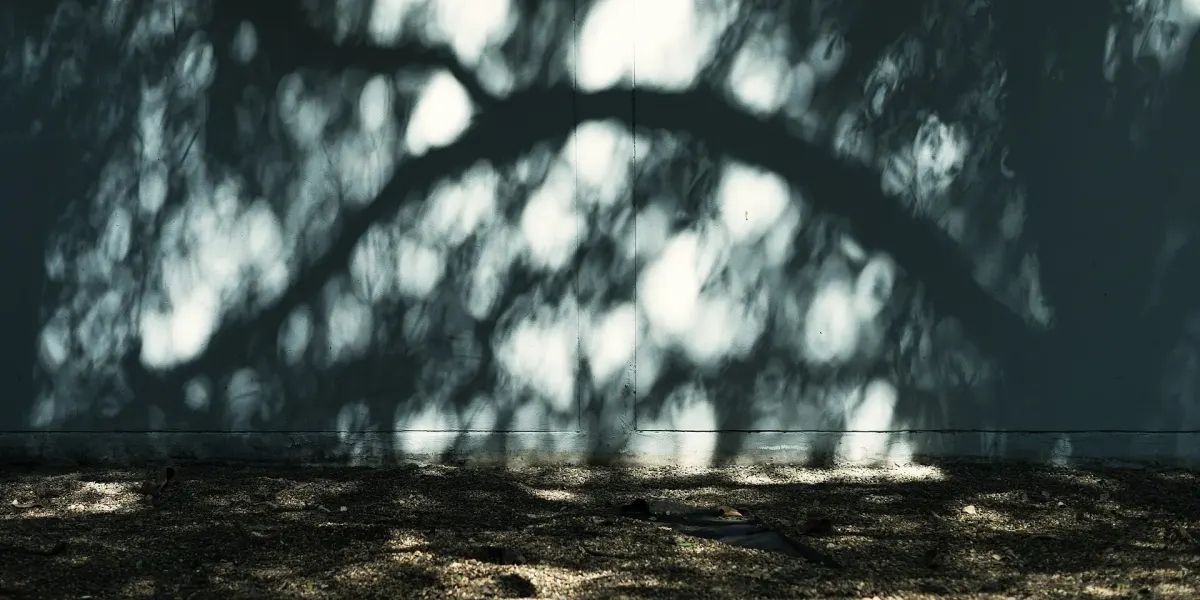
There is no object in this photograph. The tree is out of frame, and we only see what it does to the light. A wall, a strip of gravel and the shadow of a branch that curves across the middle like a bridge.
Soft edges
Shadows from a distant branch are sharp. Shadows from leaves high above are not, because the gaps between them act like pinholes and each one projects a small blurred image of the sun. The result is the scatter of pale ovals you see here. They overlap, merge and leave a dappled texture that is almost impossible to arrange on purpose.
The branch itself is the only hard shape, and it gives the pattern a spine. Without it, this would be a field of spots.
A quiet line at the bottom
Near the foot of the wall there is a thin dark line where the paint meets the ground. It is an easy detail to overlook, and it gives the eye a horizontal to rest on. The gravel below is dark and slightly warm, so the cool grey of the wall looks cooler by comparison.
If you are looking for pictures like this, they tend to appear in the middle of the afternoon, on blank walls near trees, in places nobody photographs. Stand square to the wall and wait for the breeze to settle the leaves.
It is worth saying that this is not a dramatic picture. Nothing in it is rare or hard to find. The reward is in noticing that a patch of shade on a municipal wall can carry as much structure as a cathedral ceiling, and that the best subjects are often the ones that are about to disappear when the sun moves. Take two or three frames in quick succession, because the pattern shifts every few seconds, and choose afterward.